The global processed meat industry is currently facing a critical balance between production efficiency and the demand for consistent product quality. For large-scale manufacturers, the decision of where to buy hot dog casings often depends on the trade-off between the traditional appeal of natural casings and the operational reliability of pre-processed alternatives.
Maintaining uniformity in sausage diameter and tensile strength is not merely an aesthetic concern but a technical requirement to prevent bursting during high-speed stuffing and thermal processing. As automation increases in meat processing plants, the variability inherent in raw natural casings creates significant bottlenecks in production lines and increases waste.
This analysis explores the technical shift toward dried tubed hog casings, evaluating how these materials solve the stability issues of fresh casings while maintaining a natural profile. By understanding the material properties and sourcing logic, procurement managers can optimize their supply chains for both cost-effectiveness and food safety.


Dried tubed hog casings represent a specialized processing state where the natural collagen matrix is stabilized through a drying process. Unlike salted casings that require constant refrigeration, dried tubed casings are designed for ambient storage, which fundamentally alters the logistics and cost structure for the buyer.
The primary technical advantage lies in the "tubed" format, which ensures that the casings are pre-organized and ready for rapid rehydration. This removes the manual labor associated with cleaning and preparing fresh casings, directly impacting the total cost of ownership (TCO) in a meat processing facility.
When determining where to buy hot dog casings, engineers must focus on diameter uniformity and tensile strength. A deviation of even 0.5mm in diameter can lead to uneven stuffing, causing "weak spots" that burst during the cooking or smoking phase, thereby reducing the final product yield.
Tensile strength is equally critical; the casing must possess enough elasticity to expand during the filling process without compromising the integrity of the collagen walls. Dried tubed casings are pre-processed to ensure these parameters are consistent across the entire batch, which is a significant upgrade over the variability found in raw natural sources.
Furthermore, the rehydration rate is a key operational metric. High-quality dried casings must absorb water uniformly within a specified timeframe to ensure that the material returns to its optimal pliability without becoming overly fragile or retaining an unnatural rigidity.
The "Stability-Yield Paradox" in sausage production refers to the conflict between using a casing that is strong enough to prevent bursting (stability) and one that is thin enough to allow optimal smoke penetration and a natural "snap" (yield quality).
From an engineering perspective, the reduction of defects—such as irregularities in the wall thickness—means that filling machines can operate at higher speeds. This synchronization between material reliability and machine throughput is the primary driver for shifting away from non-standardized natural casings.
Evaluating the impact of casing selection requires a quantitative look at storage and labor costs. Traditional salted casings impose a heavy burden on cold-chain infrastructure, whereas dried tubed options allow for ambient storage in cool, dry conditions.
This shift significantly lowers the energy overhead and simplifies inventory management. When assessing the overall value, the lower initial cost of dried casings is compounded by the reduction in preparation time, as no additional cleaning or complex pre-treatment is required before use.
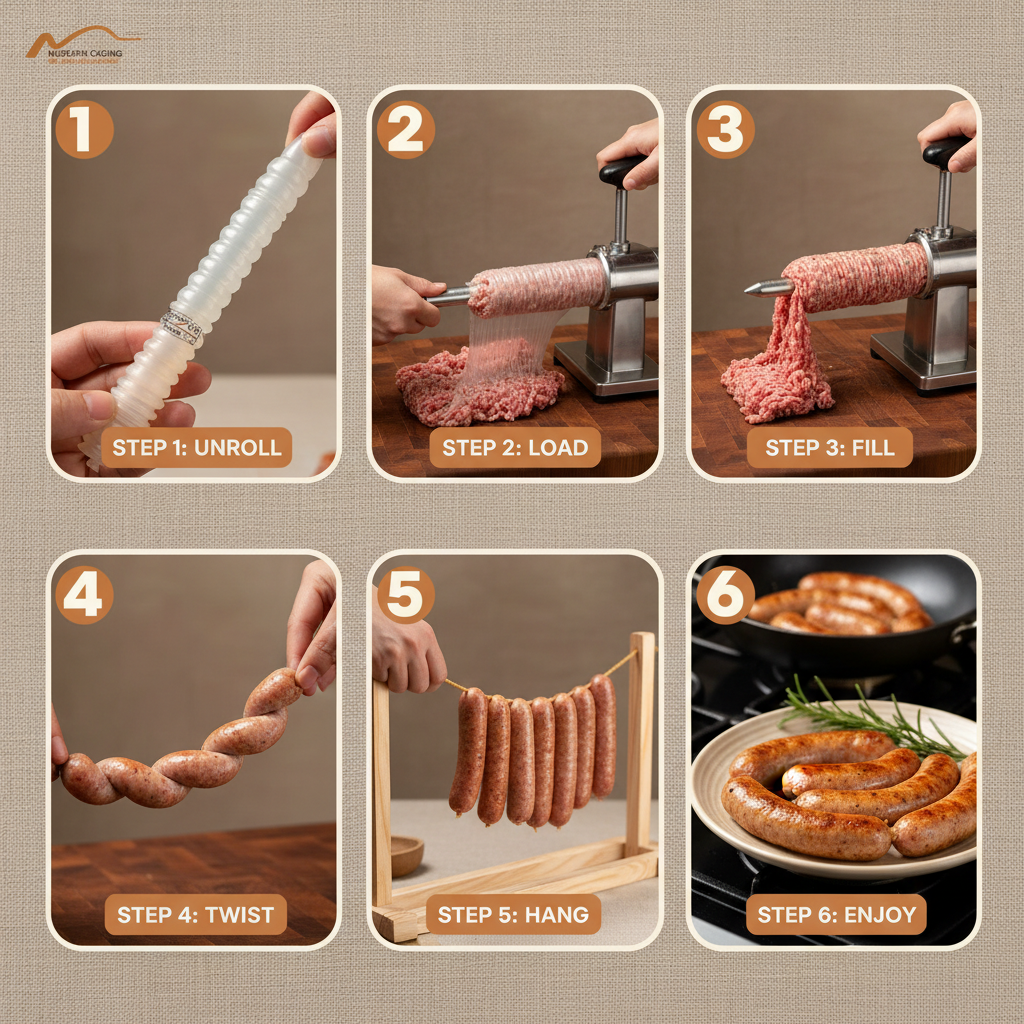
In a representative engineering scenario, a large-scale sausage producer integrates dried tubed casings into an automated filling line. The workflow begins with a timed rehydration cycle, where the casings are soaked in water to restore pliability. Because the diameter is standardized, the stuffing nozzles can be calibrated once per batch, eliminating the need for constant manual adjustments that occur with fresh casings.
This application extends beyond standard hot dogs to specialized shapes, including star, duck, or rabbit-shaped sausages. The durability of the dried tubed material allows it to withstand the unique pressures of non-linear stuffing, ensuring that the structural integrity is maintained even in complex geometries used for seasonal or specialty products.
The industry is moving toward a hybrid approach where the natural origin of the casing is preserved, but the processing is heavily standardized. The goal is to eliminate the "lot-to-lot" variability that has historically plagued the meat processing industry.
Future developments are likely to focus on enhancing the barrier properties of natural collagen to further extend the shelf life of the final sausage product without relying on synthetic additives. This trend aligns with the global consumer shift toward "clean label" ingredients, making natural-based but technologically optimized casings more desirable.
Furthermore, R&D is exploring more precise rehydration methods, such as vacuum-assisted soaking, to reduce the preparation time from hours to minutes, further increasing the agility of just-in-time production environments.
Choosing the right supplier requires a systematic evaluation of the technical profile of the casing. Procurement managers should not look at price alone but evaluate the "yield per cask" by calculating the percentage of burst casings during production.
Dried tubed casings generally offer a superior balance for industrial operations due to their standardization. For those wondering where to buy hot dog casings, the focus should be on suppliers who provide certified HACCP compliance to ensure food safety and bacterial control.
The following matrix provides a comparative framework for evaluating different configuration profiles based on common industrial requirements.
| Configuration Type | Stability Level | Storage Requirement | Recommended Use Case |
|---|---|---|---|
| Basic Dried Tubed | Moderate | Ambient / Cool | Small-scale Butcheries |
| Standard Industrial | High | Ambient / Cool | Commercial Hot Dog Lines |
| High-Duty Specialized | Very High | Ambient / Cool | Special-Shaped Sausages |
| Precision Grade | Ultra-High | Ambient / Cool | High-Speed Automation |
| Salted Natural | Variable | Refrigerated | Artisan/Premium Range |
| Industry Baseline | Medium | Mixed | General Purpose Filling |
Salted casings are preserved using salt and require constant refrigeration to prevent spoilage, which increases storage costs and energy consumption. Dried tubed casings are processed to be stable at ambient temperatures in cool, dry conditions. This eliminates the need for cold-chain logistics during storage and simplifies the inventory process, making them more cost-effective for large-scale industrial operations.
Consistency is achieved through the selection of pre-processed tubed casings that have undergone uniform diameter calibration during manufacturing. To maintain this in production, ensure the rehydration process is uniform—soaking the casings for the exact specified time in water of a consistent temperature. This prevents uneven swelling and ensures the material fits the stuffing nozzle precisely.
Bursting typically occurs due to two reasons: material defects (weak spots in the collagen wall) or excessive stuffing pressure. Using standardized dried tubed casings reduces material defects. However, operators must also ensure that the filling pressure is calibrated to the casing's tensile strength and that the cooking temperature increases gradually to allow the meat to expand without rupturing the casing.
Yes, dried tubed casings are highly suitable for special shapes such as star, Mickey, or rabbit-shaped sausages. Their superior tensile strength and elasticity allow them to be stretched and molded into non-linear geometries without tearing. This makes them an ideal choice for manufacturers producing specialty or seasonal novelty sausages that require a secure fill.
Buyers should prioritize suppliers with HACCP (Hazard Analysis and Critical Control Points) certification. This ensures that the casings are processed under strict sanitary conditions, minimizing the risk of bacterial contamination. For export-grade products, verify that the factory complies with international food production regulations and has documented quality control procedures for each batch.
The "snap" is a result of the casing's elasticity and thickness. Dried tubed hog casings provide a natural collagen structure that mimics fresh casings, ensuring a professional mouthfeel. By maintaining a uniform diameter and thickness, manufacturers can achieve a consistent snap across all units, which is a key quality indicator for consumers of high-end hot dogs and sausages.
The transition from raw natural casings to standardized dried tubed options represents a critical evolution in meat processing engineering. By resolving the conflict between organic appeal and industrial consistency, manufacturers can significantly reduce waste, lower cold-chain overhead, and increase the throughput of automated filling lines.
For procurement teams evaluating where to buy hot dog casings, the decision should be based on a matrix of diameter uniformity, tensile strength, and HACCP compliance. Investing in high-stability materials ultimately protects the final product yield and ensures a consistent consumer experience across global markets.